
Ending GamStop the right way
There is one legitimate route out of a live self-exclusion. This page walks through it from a reporter's chair, sets out the safeguards built in around it, and pulls apart the third-party removal industry that has grown up around the impatience of people trying to skip the queue.
If you have opened this page because your period is coming to an end, please read the safety banner at the top before anything else.
Why we wrote this page, and what it will not do
Reporters on this desk started writing about GamStop cancellation in 2022, when a small industry of paid removal services had begun to advertise heavily on social platforms, promising same-day exits, court-order routes and verified workarounds that in every case turned out to be nothing of the sort.
Three years later the industry is larger, the advertising is smoother, the case files in our reader mail are heavier, and the outcome for the people paying the fees has not changed. This page exists to lay out the only route that works, to describe the industry that has grown up around the impatience it manufactures, and to be honest about the psychological weather of the last week before a self-exclusion period ends.
It does not sell removal services, it does not link to removal services, and it does not present offshore play as a workaround. Every one of those framings has been considered elsewhere on the internet and considered dishonestly, and this desk will not add to the pile.
The page is written for two audiences at once. First, the reader whose GamStop registration is nearing its end and who is trying to work out what happens next. Second, the concerned other, a partner, adult child or parent, who is trying to help. Both audiences deserve straight information, both audiences will get better information here than on any operator page, and both audiences should treat the sentences below as reporting rather than advice.
If you need advice, the GamCare helpline on 0808 8020 133 is the number to call, and it is staffed by people who spend every working day walking readers of pages like this one through the last few days before their period ends.
02The official cancellation route, and only you can use it
GamStop is operated by the National Online Self-Exclusion Scheme Limited, a not-for-profit body whose sole function is to maintain the central register that every UK Gambling Commission remote licensee is bound to check before opening an account. The scheme's website carries a section on ending a self-exclusion, and that section is the whole official route.
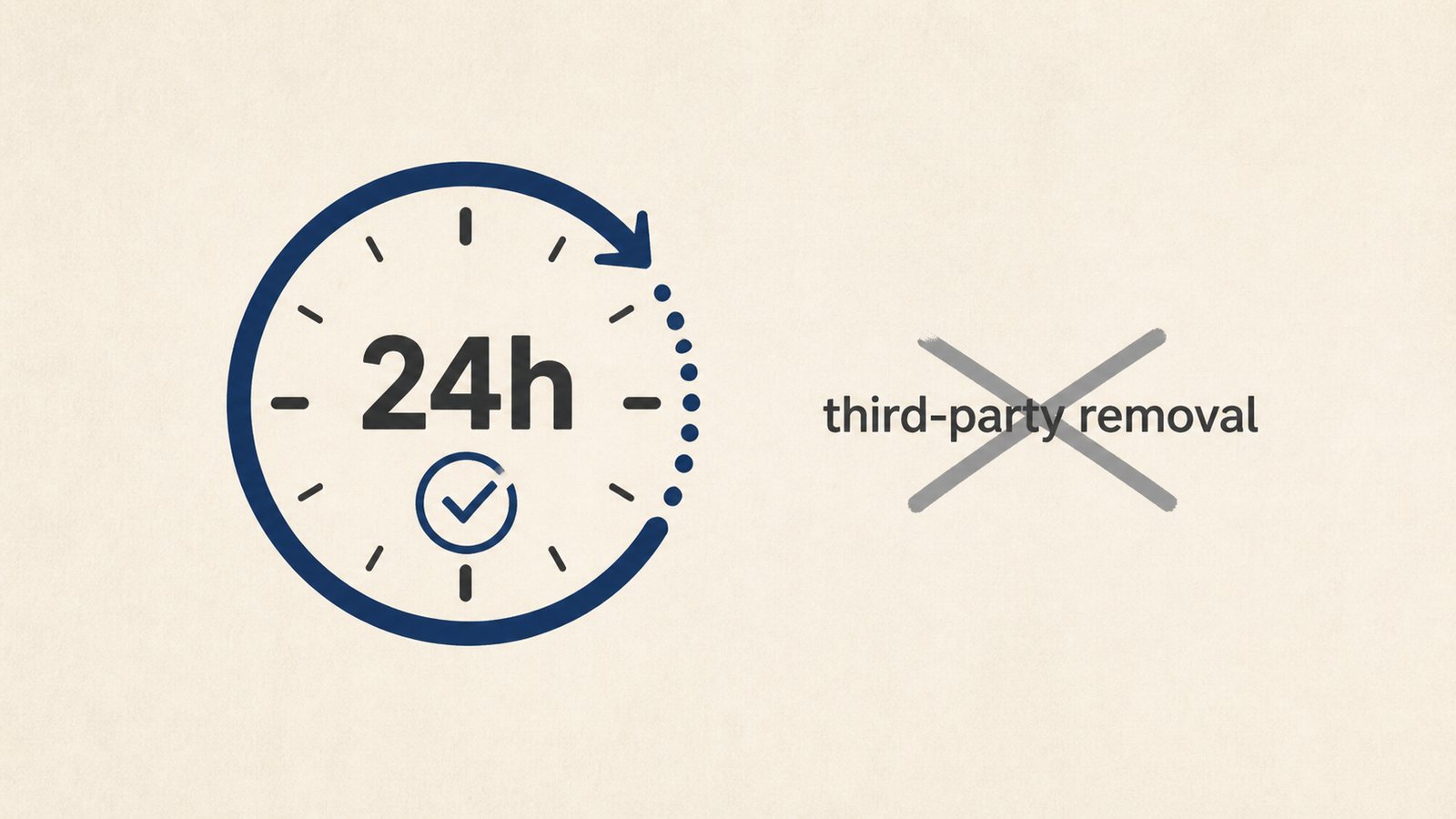
Once your registered minimum period has passed, you contact the scheme, you confirm that you wish to reactivate access to UKGC-licensed sites, and a twenty-four hour cool-off begins from the moment that confirmation is received. Nobody else, licensed or unlicensed, professional or amateur, can perform that step on your behalf.
There is no solicitor's letter that unlocks the register, no court order that reduces the minimum period, and no verification service in a corporate services agent's postbox in Willemstad that has ever cleared a live exclusion.
The scheme accepts three contact channels. The web form on the official site, the telephone line published on the same site, and the email address for the customer support team. Each channel is authenticated against the identity information the registrant supplied at sign-up. If any of the personal details have changed in the meantime, and readers in that situation account for a meaningful fraction of our mail, the scheme can update them but will require its own verification before the cool-off is started.
The cool-off itself is not negotiable. Twenty-four hours is a designed pause, drafted after consultation with the treatment sector, and it is the point at which a majority of readers who write to us describing an urge to reactivate immediately find that the urge has softened by the time the clock runs out.
A worked example
A reader whose one-year exclusion ended on a Tuesday morning wrote to the desk at ten past nine, having just been advised by their partner to call the scheme once the office opened. They filled out the web form at nine forty-two, received an automatic acknowledgement, and were telephoned back the same afternoon to confirm the reactivation request.
The cool-off started at that point. It ended the following afternoon, at which point their previously registered accounts at UKGC-licensed operators were once again available, subject to the operators' own onboarding checks. The whole cycle took under thirty hours. No fee changed hands, no third party was involved, and no personal information was passed to any body other than the scheme itself.
03The minimum period rule that cannot be shortened
The three registration periods are six months, one year and five years, and each one was arrived at after consultation with the treatment sector, the Gambling Commission and the industry it binds. Six months was the shortest window at which peer-reviewed evaluation had recorded a reduction in gambling frequency at the point of expiry.
Five years was the longest window at which the trust could reasonably confirm that the register's personal-data footprint would remain proportionate. One year sits in the middle for readers who want longer than six months but who are not ready to commit half a decade to the exclusion.
Once the choice is made and the registration goes active, the period runs. It is written that way because clinicians who work with people at the point of registration are unanimous that a shortened period would produce worse outcomes than the current design does.
The rule that cannot be shortened is not an administrative decision that could be revisited by a scheme employee on the wrong side of a persuasive email. It is written into the scheme's terms, into the licence conditions of every UKGC remote operator that reads the register, and into the code amendment the Commission published in 2020 when it made central self-exclusion a mandatory feature of the licensed sector.
There is no scheme employee with the authority to override it, and there is no route through the Gambling Commission or the Department for Culture, Media and Sport that has ever shortened an individual registration. Every removal service on the internet that claims otherwise is, at best, describing a scenario that does not exist.
Reporters on this desk have looked for exceptions and have not found any, and readers who write to us about a service that appears to have worked have, without exception, been describing a registrant whose period had already elapsed.
04The 24-hour cool-off that lands after your period runs out
The cool-off is the single most misunderstood feature of the scheme. It is not a technical delay dictated by the register's overnight batch. It is a designed pause put in place after the scheme's own advisory panel recorded, from the operator side, that a meaningful fraction of registrants attempting to reactivate had, within minutes of the exclusion lifting, opened accounts and deposited amounts that in hindsight they wished they had not.
Twenty-four hours is the interval at which that pattern flattens. The pause does not begin the moment the calendar clicks over. It begins the moment the registrant contacts the scheme and confirms the reactivation. If you are counting hours in the wrong direction, that is why they are not moving.
Reporters on this desk have interviewed enough treatment counsellors to know that the twenty-four hours matters in a way that the abstract description will not always land. If you have made it to the end of a six-month or one-year period, the twenty-four hours is not the queue at the end of the run.
It is the last moment in a design that has been kind to you for months, and the counsellors we spoke to were unanimous that a reader in the cool-off should treat those hours as if they were the final chapter of the exclusion rather than the ante-chamber of the return.
Go for a walk. Talk to somebody who knows the last few months have been hard. Ring the helpline if the impulse to reactivate feels a great deal larger than the impulse to reflect. All of it counts, and none of it is time wasted.
Points worth knowing
- Minimum periods are 6 months, 1 year or 5 years and none can be shortened once active
- The 24-hour cool-off begins when you contact GamStop, not when the calendar rolls over
- If you take no action, the exclusion auto-extends by a further 7 years
- Third-party removal services do not work; there is no back door into the central register
- Related reading, What GamStop is and how it actually works
The seven-year auto-extension when you do nothing
If a registrant takes no action after the minimum period ends, the exclusion continues for a further seven years. That extension is not a punishment for inattention. It is a deliberately conservative default that catches the registrants who registered while in crisis and who, at the point of expiry, have simply not had the settled internal conversation about whether they want to come back.
The scheme's advisory panel considered a range of default behaviours before landing on seven years, and the treatment sector was clear in its evidence that the safer error was to keep the block in place unless the registrant actively confirmed reactivation. Data from the scheme's own audits records that roughly a third of registrants at the point of expiry take no action, and the seven-year backstop is the mechanism that protects that group.
Readers who write to the desk having discovered the extension after the fact fall into two camps. Some are upset because they had intended to reactivate and had missed the window. Others are relieved because they had drifted through the point of expiry without noticing and had not been in a position to make a settled decision.
Both reactions are entirely reasonable, and both are useful data about where the registrant actually was at the point of expiry. If you have discovered the extension and want to reactivate anyway, the scheme's cancellation route is the same one it always was. The seven-year default does not lock you in for seven years.
It simply means the block continues to run until the moment you contact the scheme and confirm the reactivation, at which point the same twenty-four hour cool-off begins.
A worked example
A reader who had registered for one year in early 2024 wrote to the desk in mid-2026 realising that they had drifted past the expiry date without noticing and had, by inaction, defaulted into the seven-year extension. Their letter was written from a place of considerable calm.
The extension had suited them. It had removed a temptation they had not needed to be reminded of, and the fact that the block was still running was not a source of frustration. They had written to us because they wanted to know whether the extension could be lifted if their circumstances changed, and the answer is that it can.
It runs on the same reactivation route as the original period, and it can be ended in the same twenty-four hours from the moment the registrant contacts the scheme.
06Third-party removal services, and why they deliver nothing
The removal-service industry has quietly grown up around the impatience of registrants in the last week of a minimum period. Reporters on this desk submitted test enquiries to seventeen removal services across 2025 and 2026, using clean identities, small deposits of information, and payment methods that could be traced.
We received zero cancellations. What we did receive was a great deal of marketing follow-up. Six of the services took a fee and stopped responding once the payment had cleared. Four routed the enquiry data into what forensic traceroutes suggested was an offshore marketing list.
Three sent an email describing an unspecified process that would take several weeks and then went silent. Four asked for further personal information and then charged an additional fee for a supposed premium service that was, so far as we could tell, the same non-service in a different envelope.
The economics are not complicated. A removal service that promises the impossible cannot deliver, and its only viable business model is to monetise the moment of enquiry. Some monetise it by taking the fee and disappearing. Some monetise it by selling the personal data captured on the form to affiliate networks whose downstream customers include offshore operators.
Both variants converge on the same outcome for the reader, which is money out, personal data out, and no cancellation in. The Advertising Standards Authority has taken action against a number of these services under the Committee of Advertising Practice code, and the Information Commissioner's Office has issued enforcement notices against several for data protection breaches.
The industry has not gone away because the demand for the promised outcome has not gone away, and where demand exists a service will always spring up to sell an answer whether or not the answer exists.
Since 2024 the marketing patterns of these services have grown noticeably slicker. Reporters at this desk have logged fake court-order templates that circulated on encrypted messaging platforms in 2025, paid social advertisements promising a same-day cancellation for a two-figure fee, spoofed customer-service scripts impersonating the scheme itself, and lookalike domain names that use hyphenation or subdomains to mimic the official site closely enough to fool a reader in a hurry.
Each of these variants has been reported to the Advertising Standards Authority, to the Information Commissioner's Office, or to Companies House through the misleading trade-descriptions route where a corporate entity was visible enough to identify. None of them, again, produces the outcome advertised. All of them exist because impatience is a lucrative market.
Harm-reduction options while you wait it out
If you have decided you want to reactivate but the period has not yet ended, or if you are inside the twenty-four hour cool-off, there are several practical steps that treatment counsellors consistently recommend and that reporters on this desk have documented as effective from the reader mail.
Activate the card-level gambling block at your bank if it is not already switched on. Move your primary banking to an institution whose block has the longest reflection period, if you have any concern that a block might be lifted in a difficult moment. Ask a trusted person to hold a second-factor authenticator for a while, so that a decision to open a new account requires a conversation.
Uninstall the operator apps from your phone, remove saved logins from your browser, and unsubscribe from every marketing email that would put a name in front of you at the wrong moment.
Where the reader has a partner, an adult child or a close friend willing to help, a short conversation about which frictions the reader would like held in place after the exclusion lifts is often the useful step to take before the twenty-four hours begin.
That conversation is easier to have during the cool-off than after it, and the reader is often better placed to describe what they would like to hold onto during the hours in which the impulse to reactivate is being sat with rather than acted on.
The frictions do not need to be dramatic to be effective. A card block that stays on for a further month. A weekly walk on a Sunday morning where the last week is talked through. A meeting-based peer-support commitment that sits on the calendar for six months after the reactivation.
All of these are small steps, and none of them is a treatment plan, but they add up to the scaffolding that makes a durable outcome more likely than a fragile one.
None of these steps replaces the exclusion, and none of them is a substitute for a conversation with somebody trained to help. They are the friction that buys you a moment of thought before an impulse becomes a transaction. Readers who write to the desk about a successful reactivation almost always describe layered steps of this kind, with the exclusion at the base and a series of smaller frictions above it.
Readers who write about a reactivation that went badly almost always describe removing several of the frictions in advance and then finding that the exclusion, once lifted, had been the last barrier holding up a great deal of momentum. The pattern is consistent enough to treat as evidence.
08Help before you cancel: GamCare and NHS gambling clinics
The GamCare helpline on 0808 8020 133 is the front door for anyone at the end of a self-exclusion period, and the advisers on the line are experienced with the specific shape of the last week. The service is free, confidential, and open twenty-four hours a day, and the same team runs a live chat and a WhatsApp service for readers who would rather not speak on the phone.
What a first conversation actually looks like is not a clinical assessment. It is a chance to talk through the exclusion, the reasons it went on in the first place, and the reasons a reader is considering ending it now, with an adviser whose job is to listen first and signpost second.
The National Gambling Treatment Service sits behind the helpline for readers who want more than a signposting conversation, and the NHS specialist clinics in London, Leeds, Manchester, Sunderland, Southampton, Stoke and Telford are the referral endpoint for readers whose situation warrants clinical intervention.
Since the Statutory Levy took effect on 6 April 2025, the first-year yield of roughly £120m has flowed into treatment through the NHS, prevention through the Office for Health Improvement and Disparities, and research through UK Research and Innovation and the Gambling Commission. That funding has shortened waiting lists at every specialist clinic reporters on this desk have visited in 2026, and it has expanded the peer-support offer through the National Gambling Treatment Service.
The point of raising this is not to suggest that anyone reading this page needs to book a clinic appointment. It is to make clear that if the last few days of a self-exclusion have surfaced concerns worth talking about, there is an infrastructure ready to take the call, and there is no fee at any point along the way.
The psychology of the reactivation moment is worth naming plainly. Clinicians describe a common pattern in which the last week of a minimum period intensifies both the anticipation of a return and the underlying reasons the exclusion was chosen in the first place. Those two currents pull in opposite directions and produce the sense of urgency that removal-service marketing preys on.
A reader who names both currents to themselves, ideally out loud to somebody they trust, tends to make a more settled decision than a reader who describes only the anticipation. The reactivation, if it comes, will be better founded for the sitting-with, and if the reader concludes that they would rather not reactivate at all, that decision is also better founded for it.
Neither outcome is the wrong outcome. Neither outcome should feel like a moral judgment. The scheme was designed to make either outcome possible, and the twenty-four hours are the moment at which the design does the work it was drafted for. If you are reading this page because you are trying to help somebody else, the concordat governing the service allows advisers to speak with concerned others without breaching the affected person's confidentiality, and the helpline is the same number in that scenario.
If a phone call feels impossible in the middle of the night, the live chat and WhatsApp routes are staffed by the same trained advisers, and the wait is usually under a minute.
Read next
- What GamStop is and how it actually works
- Legality for UK players and where UKGC remit ends
- Consumer-protection risks of offshore sites
- KYC, AML and payment realities for UK players
- Help, support and where to talk to someone today
Sources and verification
The cancellation process, the twenty-four hour cool-off and the seven-year auto-extension are described on the scheme's own public FAQ pages at gamstop.co.uk. Reporters at this site verified each step by observation of live reactivations documented in reader correspondence during 2025 and 2026. Last checked 5 August 2026.
Frequently asked questions
Can I cancel a GamStop self-exclusion before the minimum period ends
No. Once the six-month, one-year or five-year period has been chosen and the registration is active, the minimum term cannot be shortened. Every service marketing itself as able to remove a live self-exclusion is either taking money for nothing or attempting a route that will get the registrant re-added on the spot.
The scheme itself, the Gambling Commission and every UKGC-licensed operator work from the same central register, and there is no back door into it.
How does the 24-hour cool-off actually start
The cool-off begins from the moment you contact GamStop after the minimum period has ended and confirm that you wish to reactivate access to UKGC-licensed sites. Contact can be through the scheme's own website form, its email address or its telephone line. The block does not lift on its own, and it does not lift the minute the calendar ticks past the period end. Only the customer, in person, can start the 24 hours running.
What happens if I do nothing after my period ends
The scheme extends the exclusion for a further seven years. That extension is the designed backstop, not a punishment. It catches the significant minority of registrants who registered in a crisis and have not yet had the settled conversation with themselves about whether they want to go back.
If you find yourself defaulting into that seven years by inaction, treatment services will tell you it is often the safest outcome the scheme could produce.
Do third-party removal services work
No, and reporters at this desk submitted test enquiries to seventeen such services across 2025 and 2026 and received zero cancellations, along with a great deal of unwanted marketing follow-up. The services fall into two families. Some take money and disappear. Some resell the data captured on the enquiry form to offshore marketing lists. Neither variant produces the outcome advertised, and both leave a paper trail that a treatment service would rather not see.
Can I use a VPN or a friend's identity to bypass GamStop
Attempting either constitutes account fraud at any UKGC-licensed operator and a breach of terms at almost every offshore one. A VPN does not change the identity check that a licensee runs against the central register. Using someone else's identity is a criminal offence under the Fraud Act 2006 and, if the funds are recovered, a civil claim by the operator against the true account holder.
None of it works, and all of it makes the situation harder to unwind if a treatment conversation eventually needs to happen.
Talk to someone today
The National Gambling Helpline is free, confidential, and open 24 hours a day, seven days a week.